
The most useful offshore staffing questions are about accountability, not price, because the real risks of offshore hiring sit in how a provider is governed rather than in what it quotes. Many businesses in Australia, New Zealand, the UK and the USA ask about rates first, then discover the gaps in security, employment practices and continuity after the contract is signed. This guide gives you nine offshore staffing questions to ask before you hire, what a strong answer sounds like, and the red flags that should slow you down. IOG Global is Australian-Registered, with offices in Melbourne and Colombo, and holds ISO 9001:2015 and ISO/IEC 27001:2022 certification, so these are questions we expect to answer ourselves.
Why the Right Offshore Staffing Questions Matter Before You Sign
The right offshore staffing questions matter because they turn a sales conversation into due diligence. Two proposals can list the same job titles, the same hours and a similar fee structure, and still differ completely in how they hire, protect data and respond to disruption.
This is the idea behind Ask Us Anything: Global Edition, our series answering the practical questions businesses ask before building an offshore team. Episode 1 explains how IOG Global builds dedicated offshore teams for businesses in Australia, New Zealand, the UK and the USA, and you can watch it on our Instagram. This article goes deeper on the thinking behind it.
Good offshore staffing questions share three traits. They are specific enough that a vague answer is obvious. They ask for evidence, such as a certificate, a written policy or a documented process. And they cover the whole relationship, from recruitment through to what happens when something goes wrong.
Are Offshore Teams Safe? What to Check on Security, Quality and Compliance
Offshore teams are only as safe as the governance behind them. Security, quality and compliance are not features of a country or a price point. They are the result of systems that someone has built, documented and had independently checked.
That is why independent certification is a useful first filter. ISO/IEC 27001:2022 is the international standard for information security management, and ISO 9001:2015 is the standard for quality management. IOG Global holds both, and the scope of our certification covers the provision of BPO services in Accounting, Finance and Mortgage, Digital Marketing, Learning and Development, and HR Services. When any provider mentions certification, ask which standard, which version and what the scope covers. “ISO certified” on its own tells you very little.
Certification is a starting point, not a finish line. Ask how the controls work in daily practice, and ask how privacy obligations are handled. In Australia, the Office of the Australian Information Commissioner explains how the Privacy Act 1988 applies to personal information, including when it is disclosed overseas. Whichever market you operate in, ask how the provider supports the privacy rules that apply to you. IOG Global operates in line with the Australian Privacy Act 1988 and is GDPR compliant.
The nine offshore staffing questions below turn these concerns into specific, checkable answers.
9 Offshore Staffing Questions to Ask Before You Hire
Use these nine offshore staffing questions in order. Each one explains why it matters, what a strong answer sounds like, and the red flag to watch for.
1. Will my team be dedicated to me, or shared with other clients?
Why it matters. Shared or rotating staff split your processes, client details and standards across several accounts. Accountability blurs, and so does your data. A dedicated team works only for you, learns your business and carries the context from one month to the next. This is the first of the offshore staffing questions because every other answer depends on it.
A strong answer. Named people, dedicated desks and a team that works for one client only. At IOG Global, every team is dedicated to one client, never shared or rotating.
Red flag. Pooled “resource banks” or an unwillingness to say exactly who will do the work.
2. Who is the legal employer, and how are staff treated?
Why it matters. People who are hired ethically, paid fairly and able to raise concerns stay longer and do better work. Your business also carries the reputational risk of how your offshore team is treated.
A strong answer. A clear employer of record, written and informed consent before employment, pay above the minimum wage and paid monthly in full, no recruitment fees charged to workers, and no document retention or wage withholding. Look for a confidential grievance channel, a non-retaliation policy and annual compliance reviews. IOG Global follows these practices, consistent with a zero tolerance approach to modern slavery, and our operations are open to client audits.
Red flag. Vague employment terms, or no direct answer on recruitment fees.
3. How is my data protected, and what has been independently verified?
Why it matters. Offshore work often involves client financials, personal information and system credentials. Promises are not controls, which is why this is one of the offshore staffing questions to ask for in writing.
A strong answer. ISO/IEC 27001:2022 certification with a stated scope, plus practical controls such as VPN access, multi-factor authentication, audit trails and encrypted backups with defined recovery times. IOG Global maintains encrypted backups with a four hour recovery time and a 24 hour recovery point.
Red flag. “We take security seriously” with nothing written to back it up.
4. How do you manage and measure quality?
Why it matters. If quality depends entirely on your own review, you have gained capacity but lost time. The value of a good offshore staffing partner is that standards are managed on their side as well as yours.
A strong answer. A documented quality management system such as ISO 9001:2015, a named team lead, supervisor sign-off before work reaches you, and regular one to one check-ins and team huddles. For accounting and finance work, ask what review steps sit between the preparer and your inbox.
Red flag. No named lead, or quality described only in general terms.
5. How do you use AI, and what happens to my data?
Why it matters. AI tools now sit inside many workflows, and a single careless upload of confidential data can undo years of trust.
A strong answer. A written AI governance policy. Client confidential, personal or NDA covered data should never be entered into an AI tool for live processing. AI output should never be client ready by default, and anything client facing should be signed off by a supervisor. IOG Global’s policy also requires that AI tools must not retain, train on or reuse client data, and every role receives AI awareness training.
Red flag. No policy at all, or staff free to use whichever tools they like.
6. What happens when something goes wrong?
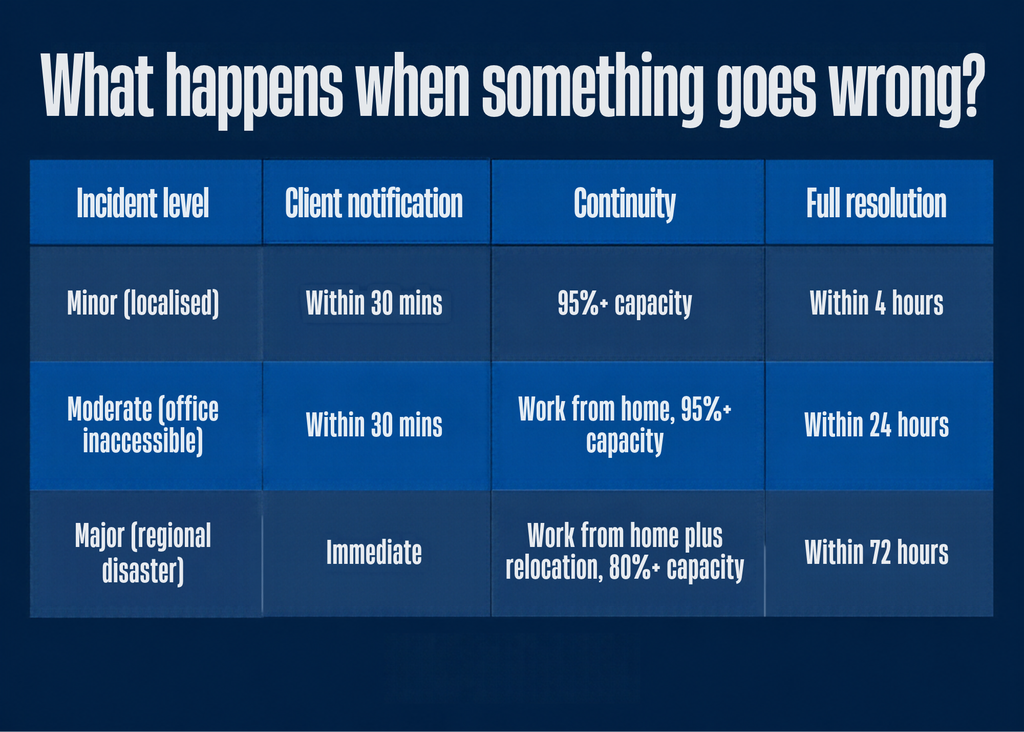
Why it matters. Power cuts, internet failures and severe weather are a matter of when, not if. What counts is how quickly you are told and how little your work is affected. Of all the offshore staffing questions, this one shows fastest whether a provider has actually prepared.
A strong answer. A documented continuity plan with numbers attached. IOG Global runs two hour UPS backup with diesel generators providing 48 hours of cover, dual internet connections with automatic failover in 30 seconds, and a fully remote ready workforce that can move to working from home within hours. Clients are notified within 30 minutes of any disruption, and service levels are defined by incident severity. Annual monsoon flooding has triggered our work from home protocols with no service interruptions recorded.
Red flag. No escalation path and no committed notification time.
7. How do you recruit, train and keep good people?
Why it matters. Turnover is the quiet cost of offshore staffing. Every departure resets the learning curve for your team.
A strong answer. A structured process that covers recruitment, onboarding, training and ongoing support. That means sourcing and screening for skills and cultural fit, background checks, contracts and payroll handled for you, day one IT readiness, customised training through a learning management system, and regular performance check-ins. Professional pathways help with retention too. IOG Global is a CPA Australia Recognised Employer Partner and an AICPA & CIMA Training Partner, and is approved by the Association of Chartered Certified Accountants (ACCA) as an employer, giving accounting staff structured routes towards CPA Australia, AICPA & CIMA and ACCA qualifications.
Red flag. “We will find someone” with no described process.
8. How will working hours and communication work across time zones?
Why it matters. Sri Lanka runs on GMT+5:30, so overlap with business hours in Australia, New Zealand, the UK or the USA is a scheduling decision, not something geography hands you. If this is left unplanned, handovers slip and questions wait overnight. Time zones rarely feature in offshore staffing questions, yet they shape every working day.
A strong answer. A roster agreed in writing before the start date, with defined handover times, a regular meeting rhythm and clear reporting. Ask who your day to day contact is and how quickly you can expect a reply.
Red flag. Claims of “perfect overlap” with no roster to prove it.
9. How will the team scale with me, and what does the contract cover?
Why it matters. Your needs will change. A good setup should grow with you without forcing a restart.
A strong answer. The option to start with one specialist and grow into a dedicated team, at any level of seniority, from entry level through to senior accountants who manage whole functions. IOG Global can handle full recruitment and ongoing compliance, including contracts, payroll and governance. Ask what the contract says about notice periods, handover and documentation, so that knowledge stays with your business.
Red flag. Long lock-in terms with unclear exit arrangements.
Strong answers to these offshore staffing questions leave you with a plan, not just a price.
Common Mistakes When Asking Offshore Staffing Questions
Even good questions fail when they are asked in a way that invites a vague answer. The best offshore staffing questions ask for evidence, and weak offshore staffing questions invite reassurance. The table below shows how to sharpen the most common ones.
| Weak question | Stronger question | What it reveals |
|---|---|---|
| Is my data secure? | Which ISO/IEC 27001:2022 scope covers my work, and what controls do you run daily? | Whether security is certified and practised |
| Are your staff good? | How are staff screened, trained and reviewed, and who signs off the work? | Whether quality is managed or assumed |
| Can you start next week? | What happens in the first 30 days of onboarding? | Whether onboarding is a process or a promise |
| Is it cheap? | What does the monthly fee include, and what is billed separately? | Whether the pricing is transparent |
Three mistakes are worth avoiding. The first is asking about price before scope, which hides the real differences between providers. The second is accepting a generic claim without asking for the standard, the version or the document behind it. The third is skipping the people questions. Retention, training and employment practices decide whether your team is still performing in a year, and they are the questions most often left out.
If you are still shaping your plan, our guide to how to build an offshore team walks through the setup in order, and our accounting and finance support shows what a dedicated team can take on.
How to Decide Once You Have Your Answers
Treat your offshore staffing questions as a scorecard. For each of the nine, mark the answer as clear and evidenced, clear but unproven, or vague. A provider with mostly clear and evidenced answers has probably built the systems to support them. A provider with several vague answers is asking you to take the risk on trust.
Compare answers across the sales conversation and the delivery team too. If the people who will manage your team give the same answers to your offshore staffing questions as the people selling the service, that consistency is a good sign. Ask to speak with the team lead who would look after your account.
A trusted offshore staffing partner will welcome this level of scrutiny. At IOG Global, we describe our process in four steps: recruit, onboard, train and support. You can ask us about any of them, and our recruitment, onboarding and training process is built to answer exactly these questions.
Offshore Staffing Questions: Quick Answers
How many offshore staffing questions should I ask before choosing a provider?
The nine questions in this guide cover the essentials: dedicated teams, employment practices, data protection, quality, AI, continuity, people, time zones and scale. Add role specific questions on top, such as which tools your team will use or which software the staff are trained in.
Which offshore staffing questions matter most for accounting providers?
Ask which certifications they hold and what the scope covers, which professional bodies recognise them as an employer or training partner, and what review steps exist before work reaches you. Keep the conversation focused on capacity and accountability, and confirm any professional obligations of your own with your regulator or professional body.
Are these offshore staffing questions relevant outside Australia?
Yes. These offshore staffing questions apply in any market, because the risks of security, employment practices, continuity and time zones are the same in New Zealand, the UK and the USA. Privacy rules differ by country, so ask any provider how they support the rules that apply to your business.
Next Step: Put These Offshore Staffing Questions to IOG Global
The right offshore staffing questions protect your business before you hire, and a good partner will answer every one of them with evidence. Book a free consultation to map your capacity needs and put all nine to us directly, through iogglobal.au.
Want more practical answers? Follow our Ask Us Anything: Global Edition series on Instagram, Facebook and LinkedIn, where we answer the questions businesses in Australia, New Zealand, the UK, the USA and beyond ask before building an offshore team.
Recent Comments